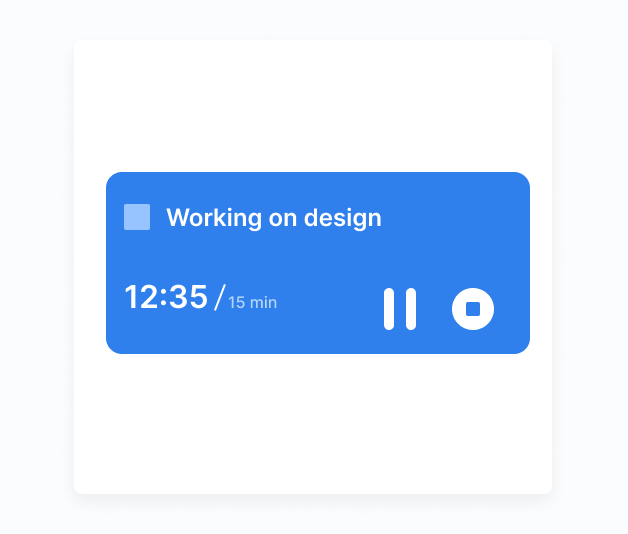
Deep work sessions with circular progress ring, session logging, and sound alerts. Choose Pomodoro, 50/10, 90-minute deep work, or a custom duration.
The classic method by Francesco Cirillo. 25 minutes of focused work followed by a 5-minute break. Best for beginners and tasks requiring frequent mental resets like coding or language learning.
The 50/10 rule is ideal for knowledge workers. 50 minutes of concentrated effort lets you enter a flow state, while the 10-minute break fully restores your attention for the next block.
Aligned with the brain's ultradian rhythm, 90-minute sessions maximize cognitive output for complex creative or analytical tasks. A 20-minute break after this session is essential for full recovery.
Set any focus and break duration that matches your schedule. Use short sessions on busy days and longer blocks when you have an uninterrupted morning or evening for deep work.
A focus timer is a simple but powerful tool that uses time-boxing — the practice of dedicating a fixed, uninterrupted block of time to a single task. By defining a clear start and end point for your work, a focus timer eliminates two of the biggest enemies of productivity: decision fatigue (constantly choosing what to do next) and Parkinson's Law (work expanding to fill all available time).
When you start the timer, you make a commitment. The countdown creates a mild, healthy urgency that keeps your brain engaged. Studies in behavioral psychology show that people perform significantly better on cognitive tasks when they work against a gentle time constraint rather than in open-ended sessions. The circular progress ring adds a visual anchor — a quick glance tells you exactly where you are in your session, reducing the cognitive load of clock-watching.
Author and computer science professor Cal Newport defines deep work as "professional activities performed in a state of distraction-free concentration that push your cognitive capabilities to their limit." Newport argues that this capacity is becoming increasingly rare — and increasingly valuable — in an economy built on complex information processing.
Psychologist Mihaly Csikszentmihalyi's research on flow state — the experience of complete absorption in a challenging task — shows that flow is not accidental. It requires clear goals, a match between challenge and skill, and crucially, an interruption-free environment. The focus timer creates these conditions by structure: you know exactly what you're working on (the intention field), for how long, and you've signaled to yourself that distractions are off the table until the ring completes.
If you are new to structured focus sessions, begin with 25 minutes (Pomodoro). After two weeks, graduate to 50 minutes. If you regularly complete 50-minute sessions without struggling, try 90-minute deep work blocks. Listen to your attention — there's no prize for suffering through a session if your mind has checked out.
Before you start, type what you're working on in the What are you working on? field. Research by Dr. Gail Matthews at Dominican University found that people who write down their goals are 42% more likely to achieve them. This applies equally to micro-goals like a single focus session. The act of naming your task primes your brain and reduces the chance of drift mid-session.
Take 60 seconds to:
This pre-session ritual conditions your brain to transition into focus mode. After a few weeks, the simple act of opening the timer will begin to trigger a focused mental state automatically.
When the timer signals the end of a focus session, actually stop. The break is not a reward — it is a required part of the cycle. During your break, move your body, look out a window at a distant object (to reset your focal depth), or practice box breathing. Avoid picking up your phone — passive social media scrolling does not restore attention.
After each session, your completed block is added to the Today's Sessions log with your task name and duration. Reviewing this log at the end of the day provides a concrete record of what you accomplished — a powerful antidote to the "I didn't do anything today" feeling that plagues deep workers.
The original Pomodoro Technique (25 minutes on, 5 minutes off) was designed by Francesco Cirillo in the late 1980s. It has helped millions of people start building a focus practice. However, many experienced practitioners find that 25 minutes is simply not long enough to reach genuine flow on complex tasks. By the time you've fully immersed yourself in a difficult problem, the timer goes off.
The 50/10 rule addresses this by doubling both the focus and break duration. You get enough time to genuinely sink into challenging work, and a full 10-minute break to walk, stretch, or meditate before the next block. For writers, programmers, researchers, and analysts, 50-minute sessions consistently outperform 25-minute ones for tasks requiring creative or analytical depth.
A single productive session is valuable. A daily practice of focused work is transformative. Cal Newport recommends scheduling deep work like a meeting — it gets a fixed time slot in your calendar, protected from shallow interruptions. Start with just one 50-minute block per day, preferably in the morning when cognitive resources are at their peak. Add a second block after two weeks. After a month, you will have built the mental infrastructure for sustained deep work.
Tracking your sessions with this tool gives you a tangible measure of your growing capacity. Watch your "Focused today" stat grow. Use it as feedback: on days when you complete four sessions, notice what made that possible. On days when you complete one, notice what got in the way. Over time, you'll learn to engineer your environment for maximum deep work output.
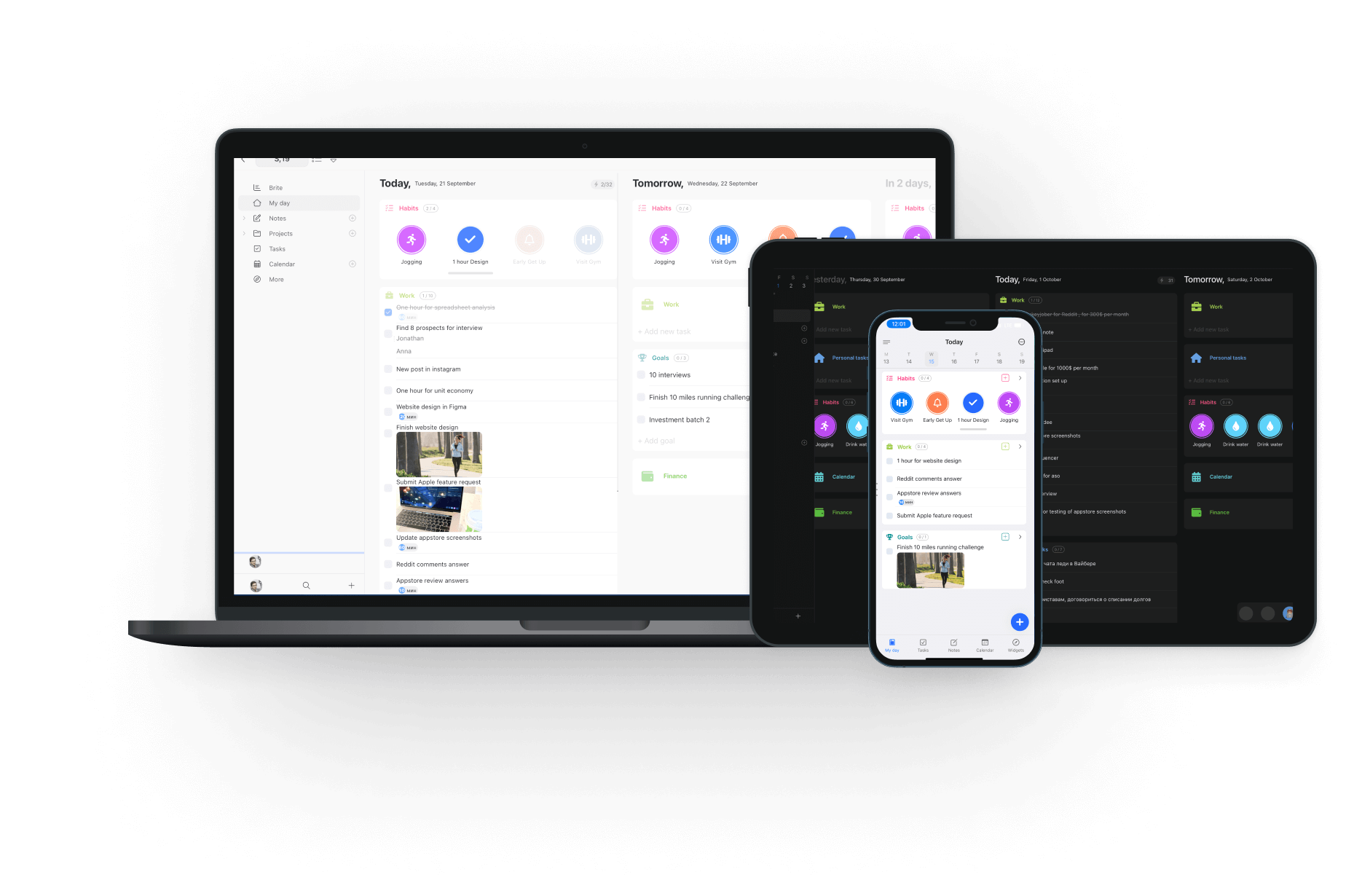
Track your daily focus sessions, build streaks, and pair deep work with habit tracking — all in one free app used by millions.
Download Brite Free